
Crowns vs Bridges vs Implants: Which Restoration Is Right for You?
When a tooth is damaged or missing, your dentist will likely discuss three options: a crown, a bridge, or an implant. Each one solves a different problem, and each comes with its own advantages, limitations, and candidacy requirements. The right choice depends on the condition of your remaining teeth, your jawbone health, your timeline, and your long-term goals.
Key Takeaways
- A crown caps a damaged but still-rooted tooth: no replacement needed, just protection and restoration.
- A bridge replaces a missing tooth by anchoring to the two teeth on either side.
- An implant replaces both the root and the crown, the most complete solution for a missing tooth.
- Implants preserve jawbone; bridges do not.
- All three are durable, natural-looking, and available at Jorgensen Advanced Dental Center in Palm Springs and Indian Wells, CA.
- The best choice depends on your specific situation: a consultation is the only way to know for certain.
Dental Crowns: Restoring a Damaged Tooth
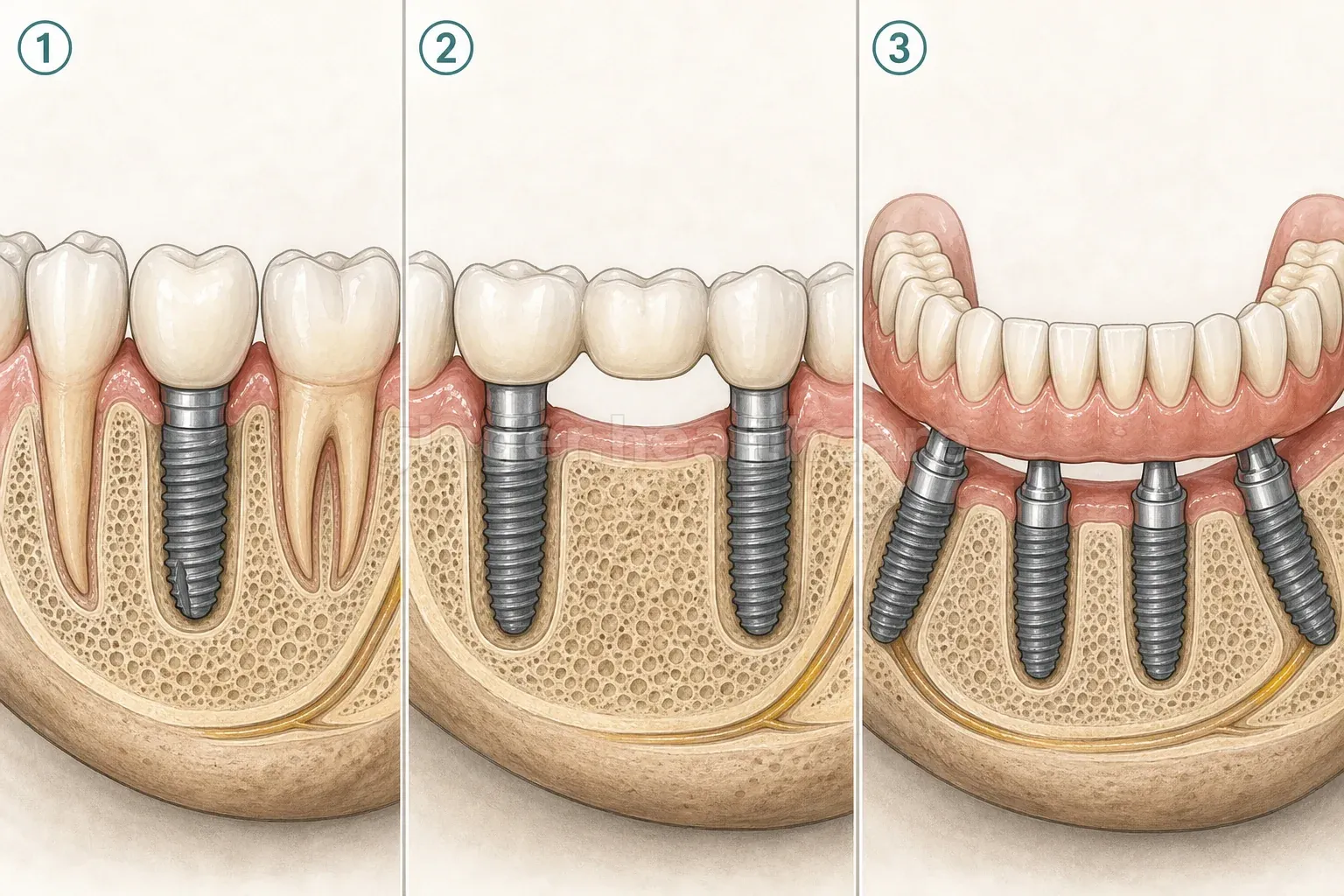
A dental crown is a tooth-shaped cap placed over an existing tooth. It restores the tooth's shape, size, strength, and appearance without removing the root. Crowns are not a tooth replacement. They are a restoration for a tooth that is still in your jaw but has been significantly compromised.
When Is a Crown the Right Choice?
Crowns are appropriate when:
- A tooth has a large cavity that can't be filled
- A tooth is cracked or fractured but the root is healthy
- A tooth has been treated with a root canal and needs protection
- A tooth is badly worn from grinding (bruxism)
- An existing large filling has failed and there isn't enough natural tooth left to support a new filling
If the tooth is still present and the root is viable, a crown is often the most conservative and cost-effective solution. You keep your natural root, which continues to stimulate the jawbone and maintain facial structure.
What to Expect
A crown procedure typically takes two appointments. At the first, your dentist shapes the tooth and takes an impression. You wear a temporary crown while a lab fabricates the permanent one. At the second appointment, your dentist cements the permanent crown into place. With modern digital impressions and same-day milling technology, some offices can complete crowns in a single visit.
Crowns at Jorgensen Advanced Dental Center are matched to the color and contour of your surrounding teeth, making them virtually indistinguishable from natural tooth structure.
Dental Bridges: Filling the Gap
A dental bridge replaces one or more missing teeth by literally "bridging" the gap. The false tooth (called a pontic) is held in place by crowns cemented onto the two healthy teeth on either side of the gap, called abutment teeth.
When Is a Bridge the Right Choice?
Bridges work well when:
- One or two adjacent teeth are missing
- The teeth on either side of the gap are healthy and strong enough to serve as anchors
- You want a faster solution than an implant (bridges typically take 2–3 weeks, versus several months for an implant)
- Jawbone loss makes implant placement more complex
- Budget is a primary consideration and you prefer to address implants later
The main trade-off with a bridge is that the abutment teeth must be permanently altered. Your dentist files them down significantly to accommodate the crowns, which means two healthy teeth are modified to support the restoration. Additionally, because there is no tooth root in the gap, the jawbone beneath the pontic will gradually resorb over time.
What to Expect
Like a crown, a bridge usually requires two appointments. Your dentist prepares the abutment teeth, takes an impression, and places a temporary bridge while the permanent one is fabricated. The final bridge is then cemented at your second visit.
Dental Implants: Replacing Root and Crown
A dental implant is the most comprehensive tooth replacement option available. It replaces both the root and the crown. Your surgeon places a titanium post into the jawbone, where it fuses with the bone over several months through a process called osseointegration. Once healed, your dentist attaches a custom crown to the post via a small connector called an abutment.
The result is a restoration that looks, feels, and functions like a natural tooth, and it actively preserves the jawbone beneath it. The American Dental Association notes that dental implants have a long-term success rate above 95% when properly placed and maintained.
When Is an Implant the Right Choice?
Implants are ideal when:
- One or more teeth are missing and you want the most durable, long-term solution
- You want to avoid modifying adjacent healthy teeth
- Preserving jawbone density is a priority
- You are in good overall health with adequate bone volume
- You are a non-smoker or willing to quit around the time of surgery
Implants are not appropriate for everyone. Candidates need sufficient bone density to support the post (bone grafting can often address deficiencies), healthy gums free of active periodontal disease, and no uncontrolled systemic conditions that impair healing.
What to Expect
Implant treatment is a multi-stage process spanning several months. Your surgeon places the implant post, then allows it to integrate with the bone over 3-6 months. Once healed, your dentist attaches the abutment and crown. Some patients with adequate bone qualify for immediate-load implants, where your dentist places a temporary crown the same day as the post.
Side-by-Side Comparison
| Feature | Crown | Bridge | Implant |
|---|---|---|---|
| What it replaces | Damaged tooth surface | Missing tooth (1–2) | Missing tooth root + crown |
| Adjacent teeth affected | No | Yes, filed down | No |
| Jawbone preservation | Yes (root still present) | No | Yes (implant stimulates bone) |
| Lifespan | 10–15+ years | 10–15 years | 20+ years with proper care |
| Treatment timeline | 1–2 visits / days | 2–3 weeks | 3–6+ months |
| Maintenance | Brush, floss, regular cleanings | Floss threader required under bridge | Brush, floss like a natural tooth |
| Cost | Contact us for a consultation | Contact us for a consultation | Contact us for a consultation |
How Jawbone Preservation Sets Implants Apart
One of the most important, and least discussed, differences between these three options is what happens to the jawbone after tooth loss.
When you lose a tooth, the jawbone that supported it begins to resorb (shrink). Without a root stimulating the bone, your body gradually reabsorbs the tissue. Over years, this can change facial structure, cause neighboring teeth to shift, and make future implants more difficult to place.
A crown doesn't involve tooth loss, so the root continues stimulating the bone normally. An implant replaces the root with a titanium post that performs the same mechanical function, preserving bone density. A bridge, by contrast, has nothing in the bone beneath the pontic. The resorption process continues, even though the gap appears closed.
For patients in their 30s, 40s, or 50s, this distinction matters significantly over a 20- or 30-year horizon.
How the Decision Is Made
The right restoration depends on a careful evaluation of several factors:
- Is the tooth present or missing? If present, a crown may be all that's needed.
- What is the condition of adjacent teeth? Healthy neighbors favor an implant; compromised neighbors may make a bridge the better fit.
- What is the jawbone status? Bone loss may require a graft before implant placement, or it may make a bridge more practical in the near term.
- What is your timeline? Bridges are faster; implants take longer but offer greater longevity.
- What are your health factors? Smoking, diabetes, and certain medications affect healing and candidacy.
At Jorgensen Advanced Dental Center, your consultation includes a thorough exam, digital X-rays, and a discussion of your goals, so you can make a fully informed decision without pressure.
Frequently Asked Questions
Is a dental implant always better than a bridge?
Not always. Implants offer superior bone preservation and longevity, but they require adequate bone density, healthy gums, and a longer treatment timeline. For patients with bone loss, faster timelines, or budget considerations, a bridge may be the more practical choice. Your dentist will help you weigh the trade-offs based on your specific situation.
Can I get an implant after having a bridge?
Yes, in many cases. If you have an existing bridge and want to transition to implants, it's possible, though the bone beneath the old bridge gap may have resorbed, potentially requiring a bone graft first. The earlier you act, the more bone is preserved and the simpler the implant procedure tends to be.
How long does a dental crown last compared to a bridge or implant?
Crowns typically last 10-15 years with proper care. Bridges have a similar lifespan of 10-15 years. Implants, when properly maintained, can last 20 years or more, and some studies show implants lasting a lifetime. The longevity of all three depends heavily on oral hygiene habits, regular dental visits, and avoiding habits like grinding.
Will a crown, bridge, or implant look natural?
All three can be made to look highly natural using tooth-colored materials (porcelain, zirconia, or ceramic). Your dentist matches the shade and shape to your surrounding teeth. Implant crowns are often considered the most natural-looking result because they emerge from the gum line just like a real tooth.
Does insurance cover crowns, bridges, or implants?
Coverage varies widely by plan. Crowns and bridges are often covered partially under major restorative benefits. Implants are frequently classified as cosmetic by insurers and may have limited or no coverage. We recommend contacting your insurance provider and scheduling a consultation with our team. We can help you understand your options and explore financing if needed.