
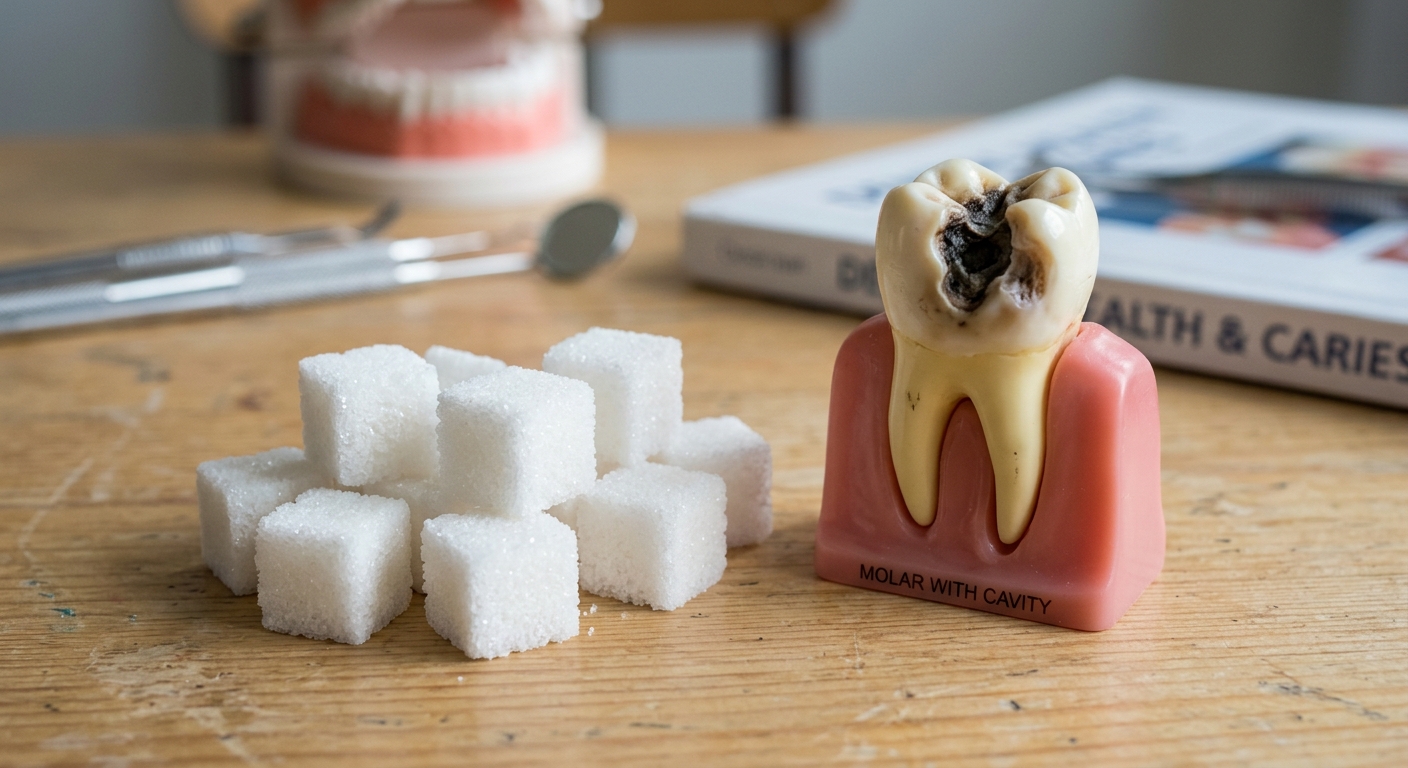
How Sugar Impacts Oral Health
Sugar doesn't rot your teeth on its own. It arms the bacteria in your mouth with everything they need to do serious damage. Every time you eat or drink something sweet, hundreds of bacterial species feast on that sugar and produce acid as a byproduct. That acid attacks your enamel for up to 20 minutes after the last sip or bite. Over time, repeated acid attacks dissolve enamel, inflame gums, and set the stage for cavities, gum disease, and tooth loss.
The good news: once you understand how the process works, you have real tools to slow it down.
Key Takeaways
- Bacteria in your mouth convert sugar to acid, which erodes enamel and causes cavities.
- How often you consume sugar matters more than the total amount: constant sipping is more damaging than one sweet meal.
- Many "healthy" foods and drinks contain as much sugar as candy.
- Sugar also feeds gum inflammation, increasing your risk of periodontal disease.
- Xylitol, a natural sugar substitute, actively reduces cavity-causing bacteria.
- Professional cleanings every six months help catch and reverse early damage.
The Science: How Sugar Destroys Enamel
Your mouth hosts over 700 species of bacteria, most of them harmless. But a handful, particularly Streptococcus mutans, thrive on fermentable carbohydrates like sugar and refined starch. When these bacteria metabolize sugar, they produce lactic acid and other organic acids that drop the pH in your mouth well below the critical level of 5.5, the point at which enamel begins to dissolve.
This process is called demineralization. Each acid attack lasts roughly 20 minutes after you stop eating or drinking. If your saliva has time to neutralize the acid, minerals in the saliva can re-deposit into the enamel through a process called remineralization, and early damage can actually be reversed. But when acid attacks come faster than your saliva can buffer them, the enamel erodes faster than it rebuilds. The result: a cavity.
Why Frequency Beats Total Amount
One of the most important, and most misunderstood, facts about sugar and teeth is this: it's not how much you eat, it's how often.
Drinking one can of soda with lunch gives your mouth roughly 20 to 30 minutes of acid exposure. Sipping that same can slowly over three hours means your mouth stays in an acidic state for nearly the entire morning. Each sip restarts the 20-minute acid attack clock.
The same logic applies to:
- Slowly dissolving hard candies or breath mints
- Grazing on crackers, chips, or dried fruit throughout the day
- Drinking sweetened coffee or tea over hours
A single dessert after dinner, followed by brushing, is far less damaging than a habit of constant snacking on "small" amounts of sugar all day.
Hidden Sugar in "Healthy" Foods
Many patients are surprised to discover that some of the most tooth-damaging foods wear a health halo. Sugar isn't limited to candy and soda.
High-sugar foods that often go unnoticed:
- Fruit juice: a small glass of orange juice contains as much sugar as a glass of soda, without the fiber of whole fruit to slow absorption
- Sports drinks: designed to replenish electrolytes but loaded with sugar and acid
- Flavored yogurt: a single serving can contain 15 to 25 grams of added sugar
- Granola and granola bars: often contain more sugar per serving than a cookie
- Dried fruit: concentrated sugar that also sticks to teeth, prolonging acid exposure
- Smoothies: blending fruit removes fiber and concentrates sugar in liquid form
- Flavored oatmeal packets: can contain 12+ grams of added sugar per packet
- Ketchup and barbecue sauce: tablespoon-sized amounts add up quickly
Reading nutrition labels for "added sugars," not just "total sugars," gives you a clearer picture. The American Heart Association recommends no more than 25 to 36 grams of added sugar per day for adults; most Americans consume two to three times that amount.
Sugar and Your Gums
Cavities get most of the attention, but sugar does significant damage below the gum line too.
The same bacteria that produce tooth-dissolving acid also trigger an inflammatory immune response in your gum tissue. When sugar feeds bacterial growth in the gum pockets around your teeth, your immune system responds by releasing inflammatory chemicals. Over time, that chronic inflammation breaks down the connective tissue and bone that anchor your teeth.
This is how gum disease begins. Gingivitis, the earliest, reversible stage, is characterized by red, swollen, bleeding gums. Left untreated, it advances to periodontitis, where bone loss occurs and teeth can eventually loosen and fall out.
A high-sugar diet consistently feeds this cycle. Patients who reduce their sugar intake often notice less gum bleeding and inflammation within weeks, before any other changes to their routine.
The Role of Saliva (and Why Dry Mouth Is Dangerous)
Saliva is your mouth's natural defense system. It:
- Neutralizes acid after meals, raising pH back toward neutral
- Remineralizes enamel by delivering calcium and phosphate ions
- Washes away food particles and dilutes sugar concentrations
- Contains antimicrobial proteins that keep bacterial populations in check
When saliva flow is reduced, a condition called xerostomia, or dry mouth, all of these defenses weaken simultaneously. Patients with dry mouth are at dramatically higher risk for cavities and gum disease, even if their diet is relatively low in sugar.
Common causes of dry mouth include:
- Prescription and over-the-counter medications (antihistamines, antidepressants, blood pressure drugs)
- Mouth breathing during sleep
- Dehydration
- Sjögren's syndrome and other autoimmune conditions
- Cancer treatment (radiation to the head and neck)
If you experience dry mouth, mention it at your next visit to Jorgensen Advanced Dental Center. There are effective strategies, from prescription fluoride to saliva-stimulating products, that can significantly reduce your risk.
Xylitol: The Sugar Substitute That Actually Helps Your Teeth
Not all sweeteners affect your teeth the same way. Xylitol, a naturally occurring sugar alcohol found in birch trees and many fruits, is uniquely beneficial for oral health.
Unlike regular sugar, xylitol cannot be fermented by S. mutans. When the bacteria ingest xylitol instead of sucrose, they are unable to produce acid, and they actually die at a higher rate than usual. Regular xylitol consumption has been shown to reduce S. mutans populations in the mouth over time.
Look for xylitol in:
- Sugar-free gum (chewing also stimulates saliva flow)
- Some toothpastes and mouth rinses
- Sugar-free mints
- Xylitol-sweetened baked goods
Chewing xylitol gum after meals, when you can't brush, is one of the most practical steps you can take to reduce acid exposure.
Practical Tips to Protect Your Teeth
You don't have to eliminate sugar entirely. Small changes in how and when you consume it make a real difference.
- Limit sugar to mealtimes. Your saliva production is highest during meals, providing more buffering capacity.
- Drink water after sweet foods or drinks. Water rinses away sugar and dilutes acid without restarting the acid clock.
- Wait 30 minutes before brushing after acidic foods. Brushing while enamel is softened by acid can cause additional abrasion.
- Choose water over juice or sports drinks. If you drink sweetened beverages, use a straw to reduce contact with teeth.
- Read labels. Look for added sugars specifically, not just total carbohydrates.
- Choose xylitol gum after meals when brushing isn't possible.
- Stay hydrated to support healthy saliva flow throughout the day.
- Keep your professional cleaning appointments every six months. Early demineralization can be reversed with professional fluoride treatment before a cavity forms.
If decay is already present, the team at Jorgensen Advanced Dental Center's Palm Springs and Indian Wells offices offers modern restorative options, including tooth-colored fillings, to repair damage and protect what remains.
Frequently Asked Questions
How does sugar cause cavities?
Sugar feeds bacteria in your mouth that produce acid as a waste product. That acid dissolves the mineral structure of your enamel through a process called demineralization. When acid attacks happen faster than your saliva can repair them, a cavity forms. It's not the sugar itself but the bacterial acid it triggers that causes the damage.
Is fruit sugar as harmful as candy sugar?
Whole fruit is far less damaging than candy because fiber slows sugar absorption and the water content dilutes it. However, fruit juice removes fiber and concentrates sugar, making it nearly as cavity-promoting as soda. Dried fruit is particularly harmful because its sticky texture keeps sugar in contact with teeth for extended periods.
Can cutting back on sugar reverse gum disease?
Reducing sugar intake lowers the bacterial load that drives gum inflammation, which can help slow or stop early gum disease. However, once bone and tissue loss from periodontitis has occurred, it cannot be fully reversed without professional treatment. Dietary changes work best as prevention and as a complement to professional periodontal care.
What is the best sugar substitute for dental health?
Xylitol is the best-studied sugar substitute for oral health. Unlike other sweeteners, xylitol is not fermented by cavity-causing bacteria, and regular use actually reduces Streptococcus mutans populations in the mouth. Chewing xylitol gum after meals is a convenient and effective strategy, especially when brushing is not immediately possible.